
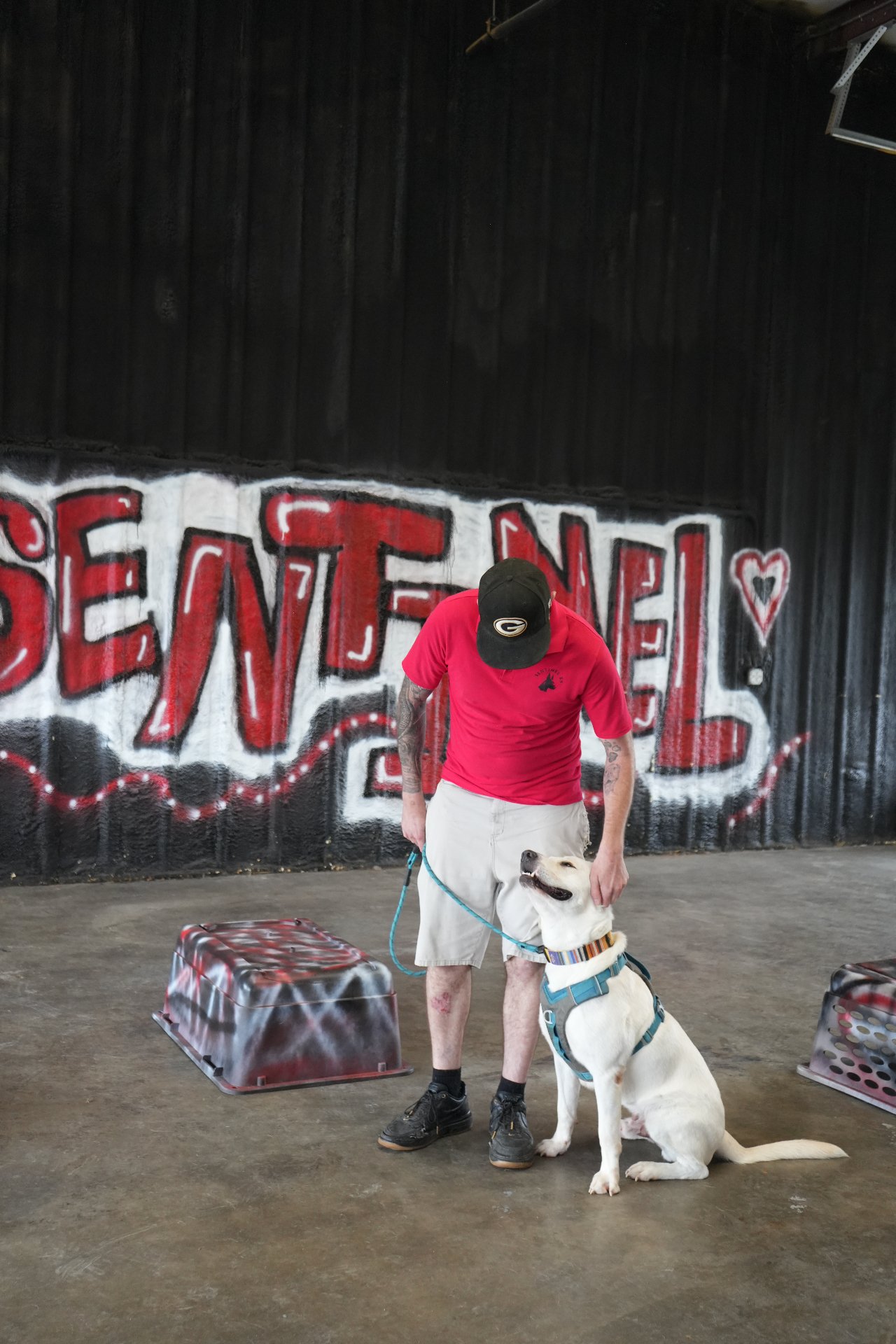
Service dog training in Texas
Task-trained work, quoted after an evaluation. We are honest about which dogs are candidates and which are not.
Plain English
What a service dog legally is
Under the Americans with Disabilities Act, a service dog is a dog individually trained to perform tasks that mitigate a person’s disability. The tasks are the legal test. A dog that has been taught specific work — retrieving medication, bracing a handler, interrupting a panic episode — qualifies.
An emotional support animal provides comfort by its presence and is not task-trained. A therapy dog visits facilities to comfort other people. Neither has the public access rights of a task-trained service dog, and we do not train either as a service dog.
Task areas
The work we train
Seizure response
Mobility
Autism support
PTSD and psychiatric
Candidate evaluation
Not every dog is a service dog candidate
What we require
- Environmental stability under noise, crowds and surfaces
- Sound temperament with no handler-directed aggression
- Clean health and orthopedic clearance appropriate to the task
- Enough drive to work, enough off switch to settle for hours
What disqualifies a dog
- Fearfulness or startle recovery that does not improve
- Reactivity toward dogs or people in public
- Resource guarding or any bite history
- Structural or medical limits against mobility work
Pricing is quoted after the evaluation because the task list, the dog and the timeline all change the scope. Program stages and the full timeline are provided in writing at the evaluation.
Public access
Why public access training matters
Task work is only half the job. A working dog also has to be invisible in public: settling under a restaurant table, riding elevators, ignoring dropped food, tolerating handling and holding position in a crowded aisle. We train that deliberately, in real venues, because a dog that cannot behave in public cannot work in public.
Owner responsibilities
What the handler carries
The dog’s training is maintained by you, daily, for its working life. That means ongoing task reps, physical upkeep, veterinary care and honest judgment about when the dog is having a bad day. Understand your rights and their limits: businesses may ask whether the dog is a service animal and what work it performs, and a dog that is out of control or not housebroken can lawfully be removed.
Call us
Service dog work starts with a conversation.
Call 817-999-6539Open 8AM–8PM, seven days a week. Closed 1:00–3:30PM daily.
FAQ
Service dog questions
Start with an evaluation.
A consultation is required before enrollment. Call and we will walk through the tasks you need and whether your dog — or a dog we source — is the right candidate.